How to Plan a Corporate Retreat on a Budget: Logistics & Cost Guide
The economic governance of professional off-site gatherings requires an uncompromising balancing act between fostering team cohesion and safeguarding operating margins. When executive teams or department leads organize company-wide getaways, lodging, travel logistics, catering, and venue rentals routinely combine to create one of the most volatile lines on the corporate ledger. Left unmonitored, peak-season destination pricing, unbundled catering minimums, and redundant transportation logistics can quickly destabilize quarterly financial projections, turning an intended morale-boosting initiative into an administrative liability.
Achieving sustainable cost efficiency while delivering a cohesive shared experience demands looking far beyond surface-level destination discounts or introductory hotel promotional rates. It requires mastering the structural mechanics of group purchasing, off-peak scheduling, alternative lodging architectures, and localized programming. This document serves as an exhaustive technical manual for designing, budgeting, and executing cost-effective team getaways, providing the structural framework necessary to master how to plan a corporate retreat on a budget across diverse operational environments.
Understanding “how to plan a corporate retreat on a budget”
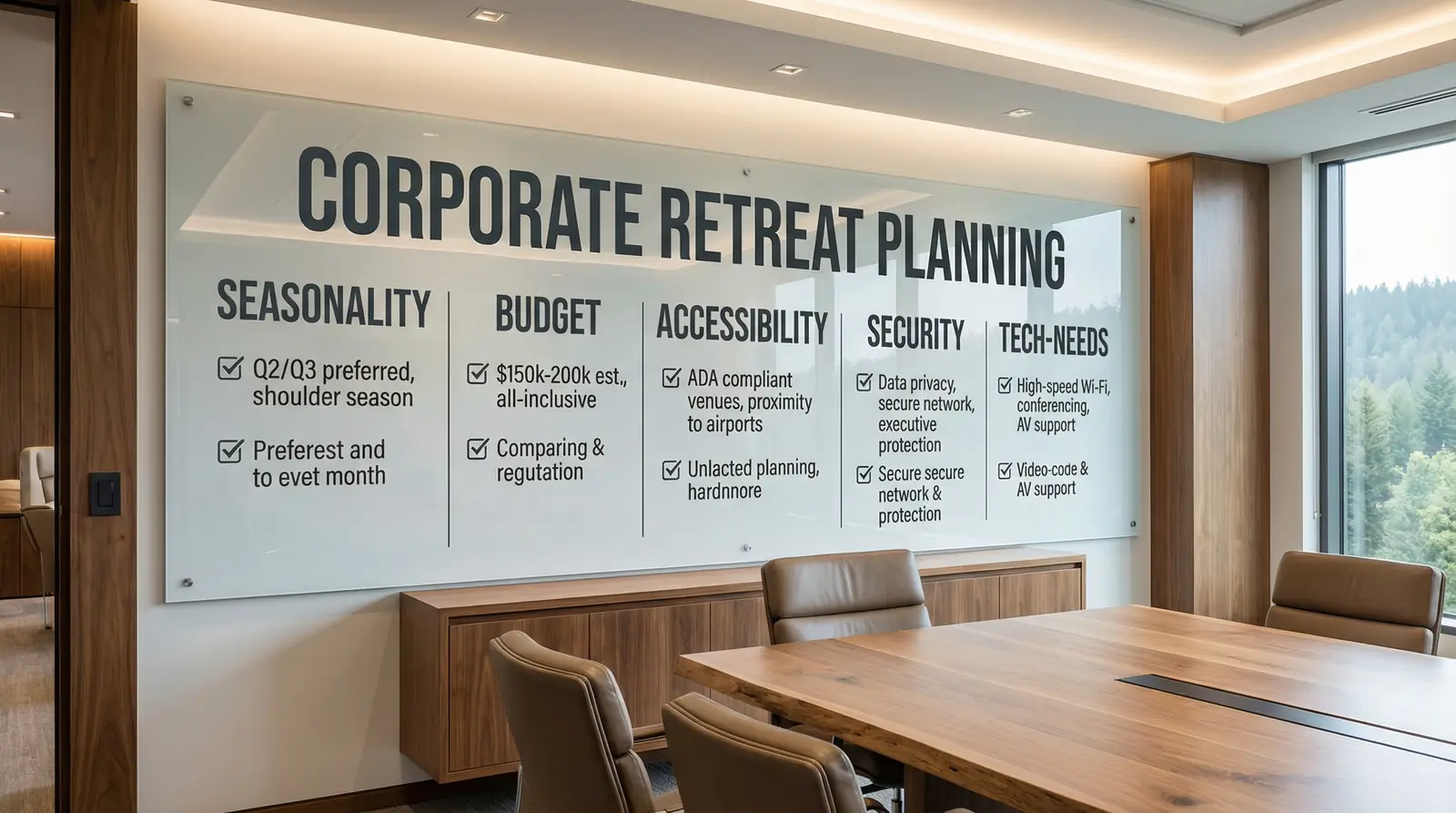
Analyzing the parameters of any professional strategy involving how to plan a corporate retreat on a budget requires separating leisure vacation planning from enterprise off-site execution. Corporate group travel is bifurcated into two distinct operational models. The first model comprises luxury hospitality packages and fully serviced corporate retreat centers, which bundle catering, AV equipment, and team-building facilitators into high-margin, all-inclusive day rates. The second model comprises modular, decentralized programming, where organizers independently source non-traditional venues, negotiate group sleeping blocks, and leverage internal facilitation resources to drastically reduce overhead expenditures.
A critical oversight in standard business literature is the assumption that reducing retreat expenses requires stripping away essential collaborative time or settling for substandard accommodations that demoralize participants. In practice, forcing steep compromises on sleeping arrangements or denying basic nutritional needs frequently backfires, resulting in fatigue, low engagement, and diminished productivity. Utilizing insights regarding how to plan a corporate retreat on a budget demands an acute awareness of total cost of occupancy, shoulder-season arbitrage, and geographic proximity economics. Reviewing these expenditures through a multi-dimensional lens reveals that selecting secondary markets, shifting dates to midweek shoulder windows, and utilizing hybrid remote-local participation yields far greater savings than attempting to negotiate minor discounts at high-demand metropolitan resorts. The physical reality of managing off-site budgets involves navigating complex group transportation logistics, catering minimums, and strict venue cancellation policies.
Deep Contextual Background: The Evolution of Professional Off-Sites and Corporate Travel Economics
The lineage of corporate off-site retreats traces its roots directly to mid-20th-century executive development seminars, military leadership training models, and the post-industrial expansion of corporate campus facilities. As multinational enterprises began decentralizing operations and establishing multi-city offices, leadership teams recognized the necessity of periodic physical gatherings to align strategic objectives, foster cross-functional trust, and combat organizational silos. Early corporate retreats typically utilized dedicated executive conference centers or university campuses during academic breaks, maintaining predictable cost structures and standardized meeting infrastructure.
Over the final decades of the twentieth century and into the digital era, the rise of remote and hybrid workforces transformed corporate retreats from luxury executive perks into essential cultural anchors for distributed teams. Concurrently, the growth of the boutique hospitality sector and specialized corporate event agencies drove costs upward, establishing luxury wellness resorts and adventure lodges as the default standard for company gatherings. This market inflation forced modern financial and operations leaders to develop advanced cost-mitigation strategies, turning budget-conscious retreat planning into an analytical discipline focused on off-peak timing, geographic arbitrage, and modular asset utilization.
Conceptual Frameworks and Mental Models
To evaluate the financial viability, logistical efficiency, and value proposition of any corporate retreat plan, industry professionals rely on several core mental models:
-
The Total Cost per Attendee (TCPA) Model: This framework calculates the aggregate financial burden of lodging, transit, food, and venue hire divided by the total number of participating employees, prioritizing high-yield per-capita value.
-
The Geographic Arbitrage Matrix: This mental model evaluates secondary and tertiary markets that offer high-quality natural or infrastructural amenities at a fraction of primary metropolitan or resort-town pricing.
-
The Temporal Value-Density Model: This model assesses how shifting events from weekend peaks to midweek shoulder days yields massive structural discounts on both lodging rates and commercial travel fares.
Key Categories or Variations
When analyzing these structural variations, sound decision logic dictates that shifting events to secondary markets during midweek shoulder windows provides the most dramatic reduction in baseline expenses without requiring compromises on participant comfort.
Detailed Real-World Scenarios and Decision Logic
Organizing a Fully Remote Engineering Team Retreat in a Secondary Market
When a mid-sized technology company with thirty remote engineers seeks to host an annual alignment retreat, the initial proposal for a premier mountain resort totals nearly one hundred thousand dollars in lodging and catering fees. The decision logic requires shifting the venue from a high-profile ski town to a scenic secondary lake district two hours away, booking an entire off-season boutique lodge on a Tuesday-through-Thursday schedule. If the company proceeds with the premier resort quote, the event consumes the department’s entire quarterly operational budget. By executing the secondary market pivot, the organization reduces total expenses by forty-five percent while securing exclusive property use and superior collaborative common spaces.
Structuring a Regional Hub Model for a Global Distributed Workforce
Inside a global enterprise with employees spread across three continents, funding long-haul flights and central lodging for a single company-wide retreat is financially prohibitive. The operational protocol requires decentralizing the gathering into three regional hubs (North America, Europe, and Asia-Pacific), utilizing local company offices and mid-tier regional retreat properties connected via synchronized live-streaming sessions for keynotes. Failure to model this decentralized approach exposes the corporate budget to unsustainable travel inflation and excessive carbon accounting liabilities.
Planning, Cost, and Resource Dynamics
The financial architecture of executing a cost-effective corporate retreat requires a sophisticated understanding of direct versus indirect expenditures, opportunity costs, and variable logistical surcharges.
Failing to establish strict budget ceilings or neglecting group concessions during early planning phases creates severe financial exposure. This oversight frequently results in post-event budget overruns and administrative friction. Consequently, financial allocation models must prioritize transparent line-item budgeting, multi-quote venue sourcing, and rigorous logistical scoping during initial development stages.
Tools, Strategies, and Support Systems
-
Specialized Group Travel Sourcing Platforms: Digital marketplaces (such as Cvent, VenueDirectory, or TROOP) utilized to solicit and compare competitive bids from diverse hospitality properties simultaneously.
-
Collaborative Shared Expense Tracking Sheets: Real-time financial dashboards monitoring cumulative spending against category caps across lodging, transit, and catering.
-
Digital Collaboration and Agenda Planning Software: Tools (such as Notion, Miro, or Airtable) used to organize structured workshop sessions, breakout tracks, and asynchronous attendee feedback.
-
Optimized Carpool and Group Transit Routing Apps: Logistics management tools designed to coordinate airport pickups, rental vans, and group transit schedules efficiently.
-
Standardized Dietary and Preference Survey Forms: Digital intake tools capturing participant food allergies, accessibility requirements, and travel constraints to prevent catering waste.
-
Comprehensive Off-Site Playbook Templates: Internal documentation outlining step-by-step procurement guidelines, emergency protocols, and expense approval workflows.
Risk Landscape and Failure Modes
-
Hidden Ancillary Venue Fees: Selecting a low-cost base lodging property that subsequently imposes exorbitant mandatory resort fees, parking charges, and AV equipment rentals that neutralize initial savings.
-
Logistical Bottlenecks in Remote Locations: Choosing an isolated venue lacking reliable high-speed internet, cellular coverage, or emergency medical access, crippling both work productivity and safety.
-
Catering Shortfalls and Dietary Mismanagement: Failing to accurately account for specialized dietary restrictions or underestimating banquet quantities, leading to hungry participants and unplanned local dining expenses.
Governance, Maintenance, and Long-Term Adaptation
Operating recurring corporate off-site programs across enterprise portfolios requires strict adherence to governance standards. Maintaining accountability demands continuous post-event reviews and proactive risk management to protect organizational resources and alignment.
-
Layered Maintenance Checklist:
-
Initial Budget Ceiling Approval: Formal sign-off by finance leadership establishing per-attendee spending caps before venue scouting.
-
Mid-Planning Expense Audit: Comprehensive review of committed contracts and estimated ancillary costs conducted sixty days before the event date.
-
Post-Retreat Financial Reconciliation: Mandatory line-by-line audit of final venue invoices and travel receipts executed within fourteen days of event conclusion.
-
Annual Retreat Program Review: Semi-annual evaluation of historical per-attendee costs, feedback scores, and ROI metrics to refine future planning playbooks.
-
-
Environmental Adaptation Triggers: Evolving corporate sustainability mandates and carbon-reduction goals require pre-established operational adjustments within retreat planning frameworks. Institutional ESG policies often mandate strict measurement and reduction of corporate travel emissions. When these standards apply, planning teams must prioritize regional ground-transit destinations over long-haul air travel. Selecting eco-certified properties that utilize renewable energy and local sourcing further reduces environmental impact without inflating baseline operational costs.
Measurement, Tracking, and Evaluation
-
Cost per Attendee Metric (CPAM): A quantitative tracking calculation dividing total combined retreat expenditures by the exact number of participating employees.
-
Participant Engagement and Satisfaction Index (PESI): Quantifying post-retreat survey feedback evaluating collaboration effectiveness, accommodation quality, and overall schedule balance.
-
Budget Variance Ratio (BVR): Measuring the percentage difference between initial projected retreat budgets and final reconciled closing invoices.
-
Productivity and Alignment Impact Score (PAIS): Assessing qualitative and quantitative indicators of post-retreat team velocity, project delivery speed, and inter-departmental cooperation.
Common Misconceptions and Oversimplifications
-
Planning a budget-friendly corporate retreat requires booking low-quality motels or unvetted rental properties. Budget efficiency is achieved through strategic secondary market selection, off-peak timing, and smart negotiation, not by compromising basic comfort or safety.
-
Weekend retreat schedules offer the most convenient timing for working professionals. Weekend bookings command premium leisure travel rates and infringe upon personal time; midweek shoulder windows deliver massive cost savings and protect work-life boundaries.
-
External keynote speakers and professional facilitators are mandatory for a successful retreat. Internal team members and peer-led workshops frequently foster deeper trust and alignment at zero external cost.
-
Booking all-inclusive resort packages eliminates hidden costs and simplifies budgeting. All-inclusive resort packages often bundle expensive luxury amenities and high service markups that a technical team does not require.
-
Corporate retreats can be successfully planned with minimal lead time if the budget is flexible. Securing advantageous secondary market rates and coordinating group travel requires a three-to-six-month procurement runway.
-
Providing open-ended meal allowances is more cost-effective than group catering. Individual expense accounts frequently lead to inflated dining costs and administrative friction during expense report auditing.
Ethical, Practical, and Contextual Considerations
Procuring corporate retreat services and managing operational budgets introduce significant administrative responsibilities. Balancing these priorities requires establishing clear internal controls and transparent reporting mechanisms. Establishing rigorous tracking systems ensures that every expenditure aligns with corporate guidelines. Implementing these safeguards prevents misallocation and reinforces institutional trust across all levels of the enterprise.
Planners and operational leaders must ensure that venue selections and supplier contracts comply with corporate governance rules. This requires actively avoiding conflicts of interest and undisclosed vendor kickbacks.
Balancing cost-cutting measures with accessibility considerations remains a fundamental responsibility for ethical organizers. Venues must accommodate individuals with diverse physical abilities and personal scheduling constraints to ensure equitable participation across the entire team.
Conclusion
Executing cost-effective team gatherings requires a sophisticated synthesis of financial analysis, geographic arbitrage, yield management, and meticulous logistical planning. Effective budget management demands moving past surface-level resort packages and peak-season scheduling. Planners must evaluate total per-capita costs, secondary market opportunities, and modular programming alternatives.
Navigating this operational landscape requires looking past promotional hospitality displays. Organizations must uncover the underlying mechanics of group procurement, contract redlining, and transparent expense governance. As corporate governance standards and global work models evolve, frameworks for sustainable team off-sites will mature. This evolution offers disciplined planners and organizations a definitive path toward cultural cohesion and long-term budgetary resilience.